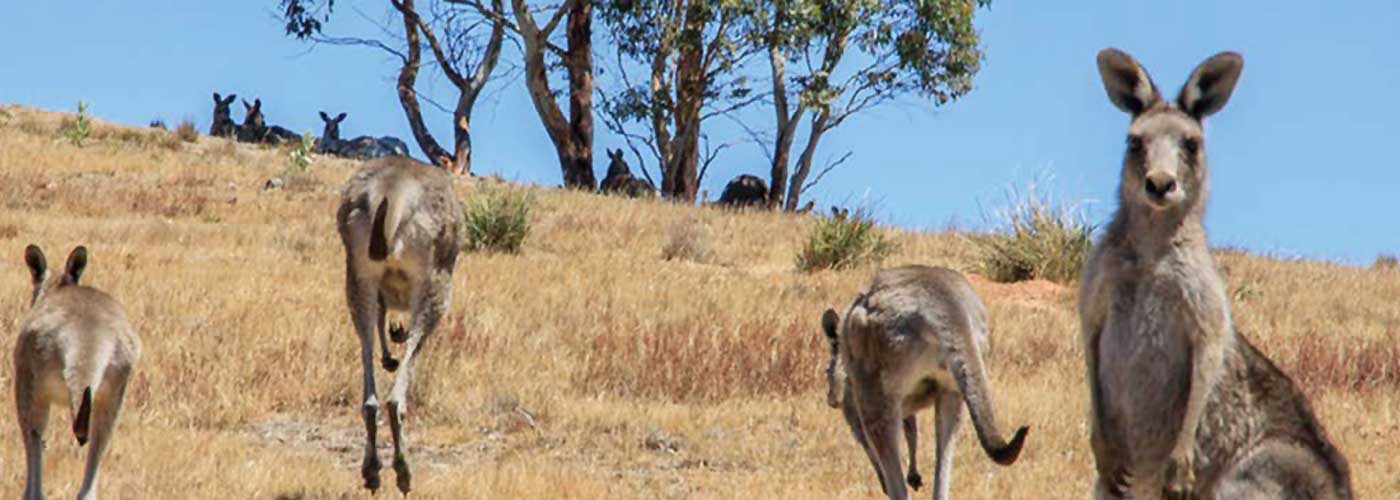
- Commercial Kangaroo Harvesters’ Handbook
- NSW Commercial Kangaroo Harvest Management Plan 2017-2021
- Commercial Kangaroo Harvesting Fact Sheet: Government roles in kangaroo harvesting
- Commercial harvesting of kangaroos in Australia
- National Code of Practice for the humane shooting if kangaroos and wallabies for commercial purposes
- National Code of Practice for the humane shooting of kangaroos and wallabies for non-commercial purposes
- Animal Welfare/Cruelty legislation
- Is there a need to kill kangaroos or wallabies?
- Australian Wildlife Management Society (AWMS)
- Nature Conservation Council
Commercial Kangaroo Harvesters’ Handbook
(NSW 2018) (Office of Environment & Heritage, 2017)
This handbook includes everything that kangaroo harvesters in NSW need to know as at 2018 regarding compliance, licencing, quotas, tags, species, zones, chillers, accessing properties and working with landholders
NSW Commercial Kangaroo Harvest Management Plan 2017-2021
(NSW Office of Environment & Heritage, n.d.)
Commercial Kangaroo Harvesting Fact Sheet: Government roles in kangaroo harvesting
(Commonwealth of Australia, 2012)
The commercial kangaroo harvest industry in Australia is one of the world’s best practice wild harvest operations, with management goals based firmly on principles of sustainability.Before approving any management plans that allow for the commercial harvest and export of kangaroo products, the Australian Government carefully considers factors such as the biology, population size and trends and conservation status of the species. Management plans must demonstrate that the harvest does not have a detrimental impact either on the harvested species or their ecosystems.Harvesting may depress populations further than if they were not harvested during drought, but historical data clearly demonstrates that this does not influence the long-term viability of kangaroo populations within the harvested areas of Australia.
Commercial harvesting of kangaroos in Australia
(Pople & Grigg, 1999)
Australian Government, Department of the Environment and Energy – overview of theory, practice, regulations and all aspects of commercial harvesting of kangaroos in the context of overall wildlife trade in Australia.
National Code of Practice for the humane shooting if kangaroos and wallabies for commercial purposes
Australia wide code of practice for commercial harvesting of macropods
National Code of Practice for the humane shooting of kangaroos and wallabies for non-commercial purposes
Australia wide code of practice for non-commercial culling of macropods
Animal Welfare/Cruelty legislation
There are no national laws applying to animal welfare, but all states and territories regulate animal welfare in their jurisdiction. The legislation in each state and territory is listed here.
Prevention of Cruelty to Animals Act 1979 (NSW Government, 2017 (Updated)
Prevention of Cruelty to Animals legislation, Victoria
Animal Welfare Act 1985 South Australia
Animal Care and Protection Act 2001 Queensland
Animal Welfare Act 1993 Tasmania
Animal Welfare Act 2002 Western Australia
Animal Welfare Act 1999 Northern Territory
Animal Welfare Act 1992 Australian Capital Territory
Is there a need to kill kangaroos or wallabies?
(RSPCA stance on kangaroo culling)
(RSPCA, 2019)
RSPCA acknowledges the need to manage kangaroo populations given changes in the way land is managed but has concerns about inhumane practices, dependent young and the fact that quota setting is not related to damage mitigation.
Australian Wildlife Management Society (AWMS)
AWMS POSITION STATEMENT Sustainable Commercial Use of Wildlife
AWMS POSITION STATEMENT Commercial harvesting of macropods
The Society believes that there is a place for the commercial, consumptive use of wildlife, and recognises that a potential for a conservation gain from the use is an important positive aspect. The Society notes that the commercial use of wildlife is in no way a novelty, with forestry and fishing being prime examples of established commercial use. This Position Statement have been developed on the understanding that the majority of AWMS members are likely to support a biocentric (= ‘conservation’) ethic, rather than an anthropocentric or animal liberation ethic.
Nature Conservation Council
(Nature Conservation Council, Adopted at 1980 Annual Conference)
NSW based conservation organisation. This policy jumps around quite a lot. It was initially adopted by the NCC at the 1980 annual conference but has a number of amendments in later years which seem to change their stance on kangaroo culling & harvesting according to the relevant situations?
- Generally opposed to the killing of kangaroos but acknowledges that there might be a need to cull certain species of macropod in times of over-population
- Supports establishment of national kangaroo study group
- Supports use of kangaroo protein and products
- But supports introduction of EXPORT ban on kangaroo products – so can be used but not exported
- Opposes skin only harvest
Supports feasibility study examining marketing drive for kangaroo products to encourage graziers to run kangaroos rather than hard footed stock